How the June 30 Marches Are Costing Joburg's Car Dealerships Their SADC Customers
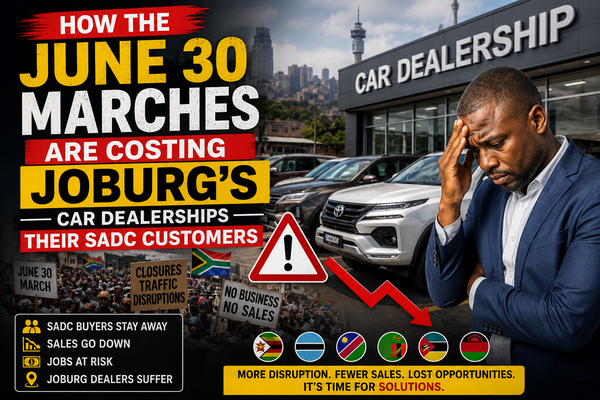
There is a particular kind of silence that settles over a car dealership when the phones stop ringing.
Not the quiet of a slow Tuesday morning. The kind that tells you something is wrong. The kind where salespeople refresh WhatsApp and wonder whether to call back customers who haven't responded in days — customers who, until last week, were asking about finance terms, booking inspection dates, and negotiating prices on vehicles they genuinely wanted to buy.
That silence has settled over dealerships like Cars Gold on Louis Botha Avenue in Highlands North — and over dozens of others like it across Johannesburg. And it has nothing to do with stock. Nothing to do with interest rates. Nothing to do with the vehicles themselves. It has everything to do with fear.
The customers who aren't coming
For years, dealerships along the Louis Botha Avenue corridor have served a customer base that stretches far beyond Johannesburg's suburbs. Buyers from Zimbabwe, Mozambique, Malawi, Zambia and across the SADC region have made South Africa — and Johannesburg specifically — a destination for vehicle purchases. They come because the selection is unmatched in the region. Because the documentation infrastructure — eNaTIS records, roadworthy certificates, SARS clearance — is among the most developed on the continent. Because they trust the process.
These are legal travellers. They cross borders with valid documents. They come to spend money, take a vehicle home, and contribute to the South African economy in the most direct way possible: cash in hand, deal done. Right now, they are not coming. And who can blame them?
What they are seeing Across social media — the same platforms where SADC buyers research vehicles, compare prices, and ask for recommendations — a very different South Africa is visible this week.
Videos of people being evicted from homes. Shops shuttered. Crowds moving through Johannesburg neighbourhoods. The March and March movement, which set 30 June 2026 as a deadline for undocumented migrants to leave the country, has generated a wave of images and footage that travels instantly across WhatsApp groups in Harare, Lusaka, Maputo, and Lilongwe.
The ISS Africa Institute, writing this week, was blunt about who gets caught in the crossfire: "While ostensibly aimed at undocumented migrants, in practice those targeted frequently include anyone perceived to be an immigrant of African or Asian origin — whether in South Africa legally or not."
A buyer from Zimbabwe does not need to read a legal brief to understand what that means. They see it. They feel it. And they cancel the trip. The numbers that explain the stakes
South Africa's car market entered June 2026 on extraordinary momentum. New vehicle sales hit 51,000 units in May alone — a 10-year high, up nearly 13% year-on-year. The automotive sector was, by every measure, thriving.
At the same time, over 13,200 foreign nationals were processed through Beitbridge and OR Tambo International Airport in just five days as people fled ahead of the 30 June deadline. Hundreds of Zimbabweans lined up outside their consulate in Johannesburg, belongings packed, seeking help to get home. An estimated 7,000 people remained at the Durban repatriation site alone.
These are not abstract statistics. These are people who, under different circumstances, might have been browsing forecourts on Louis Botha Avenue. Negotiating on a Toyota Hilux or a Nissan NP200. Arranging cross-border documentation to drive their new vehicle home. Instead, they are leaving.
What this costs a dealership
A dealership like Cars Gold does not operate on large margins. Monthly expenses — rent, salaries, floor plan finance, insurance, marketing — are fixed whether five cars sell or fifty. Cross-border SADC buyers are not a niche segment for businesses in this corridor. They are a core market. They buy vehicles outright or arrange finance. They often purchase without extended negotiation. They return, and they refer.
When that pipeline dries up — even for a few weeks — the damage is real and immediate.
There is no government relief fund for a dealership whose SADC clients stopped coming because they saw violence on their timelines. There is no insurance policy for the reputational damage that takes months, sometimes years, to repair.
The 2008 xenophobic violence offers a painful reference point. That outbreak left South Africa's reputation across the SADC region scarred for close to a decade. Cross-border business confidence does not bounce back overnight. The fear that a buyer feels this week does not simply disappear once the news cycle moves on. A gap between words and reality
President Ramaphosa has been clear in his public statements. He condemned attacks on foreign nationals. He warned against scapegoating. He said security forces were on high alert and that June 30 must remain "a normal working day."
Acting Police Minister Firoz Cachalia reinforced the message: no group would be allowed to take the law into its own hands.
These are the right words. But on Louis Botha Avenue, the effect of those words on the ground has not been enough to bring buyers back to showrooms this week.
There is a gap between what the government says and what the market is experiencing. Small and medium dealerships — the ones that actually employ people, pay rates, and service communities — are absorbing that gap in their June sales figures.
This is an economic story, not just a political one
The debate around immigration, documentation, and border enforcement is a legitimate one. South Africa faces real pressures, and many of the frustrations driving the march movement are rooted in genuine hardship.
But there is a cost to how that debate plays out — a cost that falls on businesses and buyers who have done nothing wrong. Cars Gold is not a political organisation. It is a dealership. Its staff have families, bond repayments, and school fees. Its SADC clients are legal visitors exercising their right to trade across borders.
When fear replaces commerce, everyone loses.
South Africa cannot simultaneously position itself as the automotive hub of sub-Saharan Africa and allow the conditions that drive legitimate buyers out of the country. The two ambitions are incompatible.
What needs to happen: The government has promised that law enforcement will act decisively. That is necessary. But it is not sufficient.
What businesses like Cars Gold need — and what the broader automotive sector needs — is a clear, sustained signal to the SADC region that South Africa is open for business. That legal travellers are safe. That the buyers who have trusted this market for years can continue to do so.
That signal needs to come from leadership, from industry bodies, and from the dealerships themselves.
In the meantime, the phones on Louis Botha Avenue are quieter than they should be. And every day they stay quiet is a day South Africa's car industry pays the price for a crisis it did not create.
Cars Gold is a used vehicle dealership based in Highlands North, Johannesburg, serving buyers across South Africa and the SADC region. This article reflects the direct commercial impact of current events on independent dealerships and cross-border automotive trade.
Sources: ISS Africa (June 2026) · CNN Africa (June 2026) · Inside Metros (June 2026) · NAAMSA May 2026 sales data · Daily Maverick (June 2026) · NADA South Africa
