How SADC Buyers Can Purchase Vehicles from South Africa: A Step-by-Step Guide
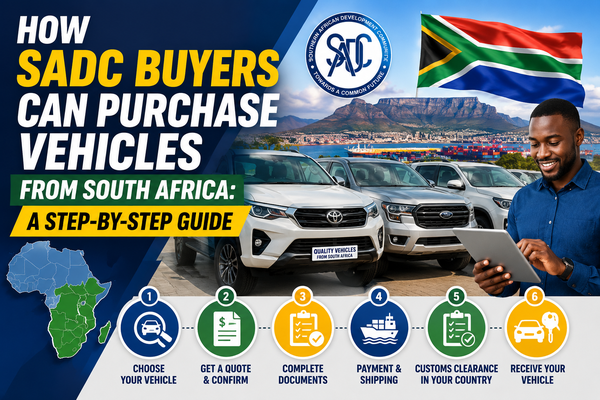
If you live in Zambia, Zimbabwe, Botswana, Mozambique, Namibia, or anywhere else in the SADC region, there's a good reason you're looking at South African vehicles: a deeper used-car market, better-documented ownership history, and pricing that's often more competitive than sourcing from further afield. The challenge isn't finding a good car. It's knowing the right order of operations so you don't lose money to avoidable delays, bank fees, or border surprises.
This guide walks through exactly how to buy a car from South Africa as a SADC buyer, from your first inquiry to driving it home.
Step 1: Decide What You're Actually Buying — and Confirm It's Allowed In
Before you fall in love with a specific vehicle, check your home country's import rules. They vary more than most buyers expect:
- Zimbabwe: a 10-year age limit applies to most vehicles (commercial trucks and specialized equipment are exempt), and a pre-shipment conformity inspection is required before the car crosses the border.
- Zambia: there's no hard age limit, but vehicles older than five years attract a 20% surtax on top of standard duty, so the math can shift quickly on an older car.
- Botswana, Namibia, Lesotho, Eswatini: as fellow members of the Southern African Customs Union (SACU), these countries benefit from freer movement of goods with South Africa than non-SACU SADC states do.
Rules like these get updated periodically, so it's worth confirming current requirements with your local revenue authority or clearing agent before you commit to a vehicle — especially around age limits and inspection requirements, since those affect what you're even allowed to shop for.
Step 2: Choose Your Vehicle and Confirm the Paperwork Is Clean
Once you know what you're allowed to import, the actual selection process is straightforward: agree on the vehicle, price, and condition with the dealer, and request the documentation that proves the car is legitimately saleable. At minimum, ask for:
- Proof of ownership and registration (eNaTIS records in South Africa)
- Confirmation the vehicle is free of outstanding finance — if it isn't, the settlement letter from the bank has to be obtained first, and this is one of the most common causes of delay, often taking 5–10 working days
- A roadworthy or condition report, particularly for older vehicles
A reputable South African dealer or exporter should be able to produce all of this without hesitation. If they can't, treat it as a red flag.
Step 3: Settle Payment
Payment is typically handled through bank transfer once both parties agree on terms, with funds usually held or released against confirmed documentation rather than upfront on a handshake. If you're working through an exporter rather than buying directly, ask exactly when funds change hands relative to police clearance and export permit approval — this protects you if something stalls partway through.
Step 4: Export Compliance — What Happens on the South African Side
This is the part most buyers never see, but it determines your timeline. Before any vehicle can legally leave South Africa, the seller or their agent typically needs to handle:
- ITAC export permit (Form IE362) — submitted to the International Trade Administration Commission; processing usually takes several working days.
- SAPS police clearance — the vehicle's VIN and engine number are inspected at an accredited Vehicle Clearance Unit to confirm it isn't stolen and that the identification numbers match official records.
- SARPCCO clearance — a regional safeguard required for most exports within SADC, layered on top of standard police clearance to enable cross-border verification. This step is what gives border officials in your country confidence that the vehicle is legitimate.
- eNaTIS deregistration — for permanent exports, the vehicle is removed from South Africa's national vehicle register, after which it can no longer be used on South African roads.
- SARS customs documentation (SAD500) — the customs clearance form required for final release at the port or border.
None of this is something you need to personally execute, but understanding it helps you ask the right questions and recognize a legitimate, well-run export process when you see one.
Step 5: Choose How the Vehicle Will Travel
For most SADC destinations, road freight is the standard option, with vehicles typically routed through established corridors — for example, through Beitbridge for Zimbabwe-bound vehicles, or via Botswana or Zimbabwe en route to Zambia. Sea freight (RoRo or container) is also used in some cases, particularly for vehicles departing through ports like Durban.
Your dealer or a logistics partner should confirm the route, transit time, and whether your specific vehicle and destination call for road or sea transport.
Step 6: Customs Clearance in Your Home Country
Once the vehicle crosses the border, it still needs to clear customs on your end — through the Zambia Revenue Authority, ZIMRA, or the equivalent body in your country. This is where import duty, VAT, and any applicable surtax get calculated, usually based on the vehicle's CIF (cost, insurance, freight) value. A licensed clearing agent in your home country can help you avoid valuation disputes here, which is one of the more common friction points for first-time importers.
One detail worth knowing about: if your vehicle qualifies as South African-origin and you can secure a SADC Certificate of Origin, it may be eligible for reduced or zero import duty under the SADC trade agreement. Ask your dealer whether the vehicle qualifies and whether they can provide the certificate — it's a straightforward way to lower your total cost.
Step 7: Final Handover
Once customs clearance is complete and duties are paid, you should receive a full document pack — typically including the bill of lading or transport documentation, export and clearance certificates, and proof of deregistration from South Africa. Keep these; you'll need them for local registration and licensing in your home country.
A Realistic Timeline
For neighboring countries like Zimbabwe, Zambia, and Botswana, the full process — from finalizing the purchase to the vehicle clearing customs at home — commonly takes two to four weeks, assuming documentation is in order and there's no outstanding finance to settle. Financed vehicles or incomplete paperwork are the two things most likely to stretch that timeline.
What to Ask Your Dealer Before You Commit
A good exporter will walk you through all of this without being asked, but it's worth confirming directly:
- Is the vehicle free of finance, and if not, how long will settlement take?
- Will you handle SAPS and SARPCCO clearance, or do I need to arrange that separately?
- Does this vehicle qualify for a SADC Certificate of Origin?
- Which route and transport method do you recommend for my destination, and what's the realistic timeline?
- What documents will I receive, and when?
Buying a car from South Africa as a SADC buyer is a well-established process with clear steps — the buyers who have the smoothest experience are simply the ones who know what those steps are before they start.
Import regulations, duties, and age restrictions are updated periodically by national revenue authorities. Always confirm current requirements with your local customs authority or a licensed clearing agent before finalizing a purchase.
